DRAGON eVTOL — Fixed-Wing to Multirotor Transition
PX4 firmware modification, gain-scheduled LQR/PID transition control laws, and first demonstration of stable fixed-wing-to-multirotor flight
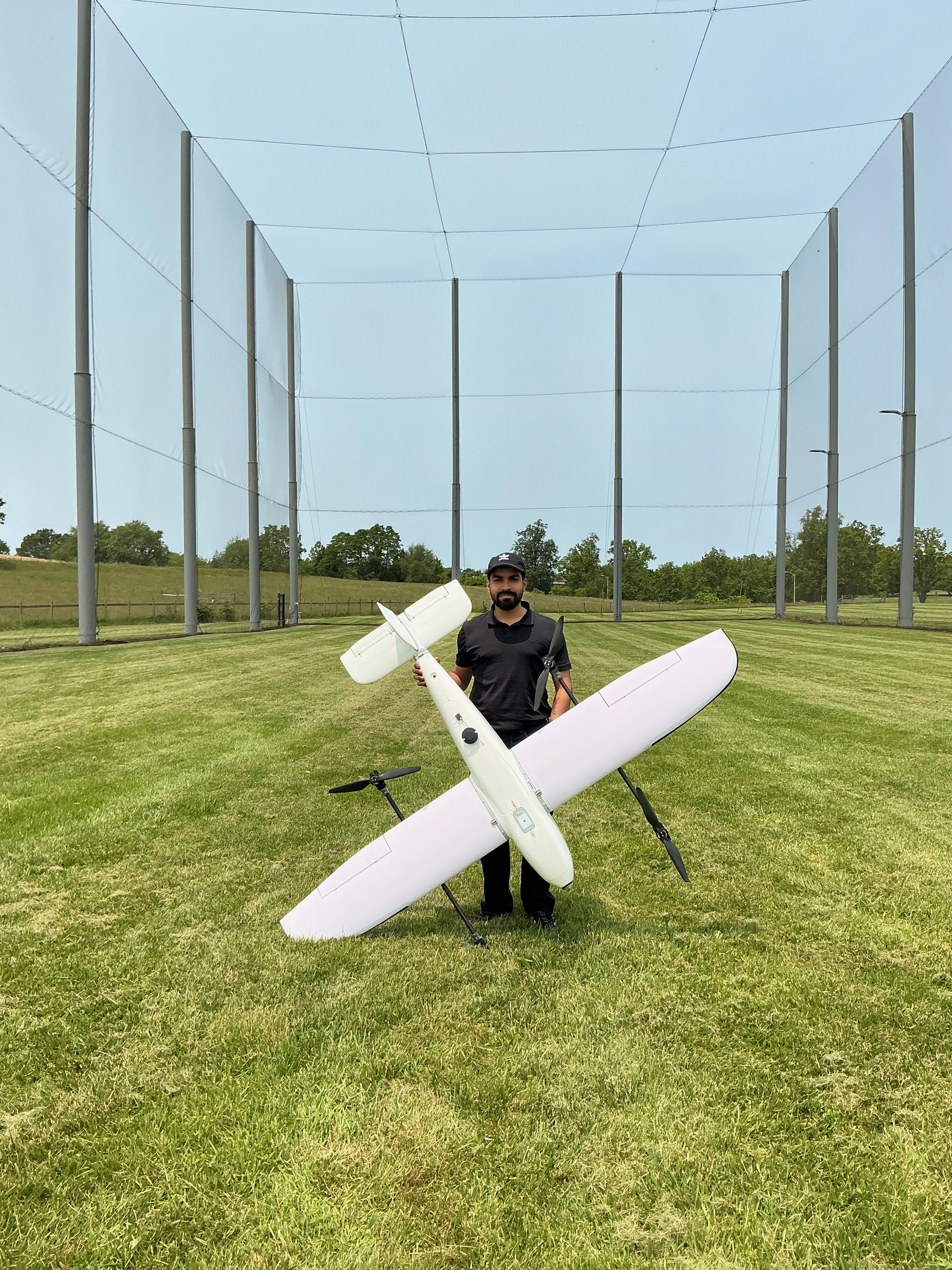
Took GNC ownership of the DRAGON eVTOL platform at Virginia Tech’s Nonlinear Systems Laboratory, culminating in the platform’s first stable fixed-wing-to-multirotor transition in flight.
The Transition Problem
During conversion from fixed-wing to multirotor mode, both the aerodynamic regime and the effective control authority change simultaneously. At high forward speed, control surfaces dominate; at low speed, rotors take over. The transition corridor sits between these two extremes, where neither set of actuators is fully effective.
The goal is to maintain stability and trackability across the full corridor without discrete switching transients.
<!--
  See https://www.debugbear.com/blog/responsive-images#w-descriptors-and-the-sizes-attribute and
  https://developer.mozilla.org/en-US/docs/Learn/HTML/Multimedia_and_embedding/Responsive_images for info on defining 'sizes' for responsive images
-->

  <source
    class="responsive-img-srcset"

      srcset="/assets/img/personal/dragon_transition.gif"


      sizes="95vw"

  >

<img
  src="/assets/img/personal/dragon_transition.gif"

    class="img-fluid rounded z-depth-1"


    width="100%"


    height="auto"


    alt="DRAGON eVTOL transition animation"


    data-zoomable


    loading="lazy"

  onerror="this.onerror=null; $('.responsive-img-srcset').remove();"
>
</picture>
</figure> –>
Transition flight animation — coming soon
Gain-Scheduled LQR
The airframe is linearized at a series of trim points indexed by airspeed \(V \in [V_{\min},\ V_{\max}]\):
\[\dot{x} = A(V)x + B(V)u\]At each trim point, an LQR gain \(K(V)\) is computed by solving:
\[A(V)^\top P + PA(V) - PB(V)R^{-1}B(V)^\top P + Q = 0, \quad K(V) = R^{-1}B(V)^\top P\]Gains are interpolated in real time as a function of measured airspeed, providing continuous stability coverage across the transition corridor.
\[K_{\text{sched}}(V) = (1 - \alpha(V)) K_{\text{mc}} + \alpha(V) K_{\text{fw}}, \quad \alpha(V) = \frac{V - V_{\min}}{V_{\max} - V_{\min}}\]PX4 Firmware Modifications
Standard PX4 supports fixed-wing and multirotor separately with a discrete mode switch. DRAGON required a custom blended control allocator that simultaneously commands rotors and control surfaces during transition, with authority split scheduled by airspeed.
Key firmware changes (C++):
// Blended control allocation during transition
float alpha = get_transition_factor(airspeed_m_s);

// Blend rotor and surface commands
actuator_out.rotor   = alpha * mc_out.rotor + (1.0f - alpha) * fw_out.rotor_trim;
actuator_out.aileron = (1.0f - alpha) * fw_out.aileron + alpha * mc_out.aileron_trim;
actuator_out.elevator = fw_out.elevator;
Path Planning Through the Transition Corridor
The transition is executed along a planned trajectory that trades altitude for airspeed in a controlled dive, ensuring the vehicle reaches fixed-wing trim speed before full surface authority is engaged. The path is parameterized as:
\[\begin{bmatrix} \dot{x} \\ \dot{z} \end{bmatrix} = \begin{bmatrix} V\cos\gamma \\ -V\sin\gamma \end{bmatrix}\]where \(\gamma\) is the flight path angle, held constant during the speed transition phase.
Results
| Metric | Value |
|---|---|
| Transition airspeed range | 8 – 18 m/s |
| Altitude loss during transition | < 4 m |
| Attitude deviation (max) | < 8° |
| Time to complete transition | ~4 s |
The platform successfully completed the transition corridor and recovered to stable multirotor hover, marking the first successful demonstration of this maneuver on the DRAGON airframe.